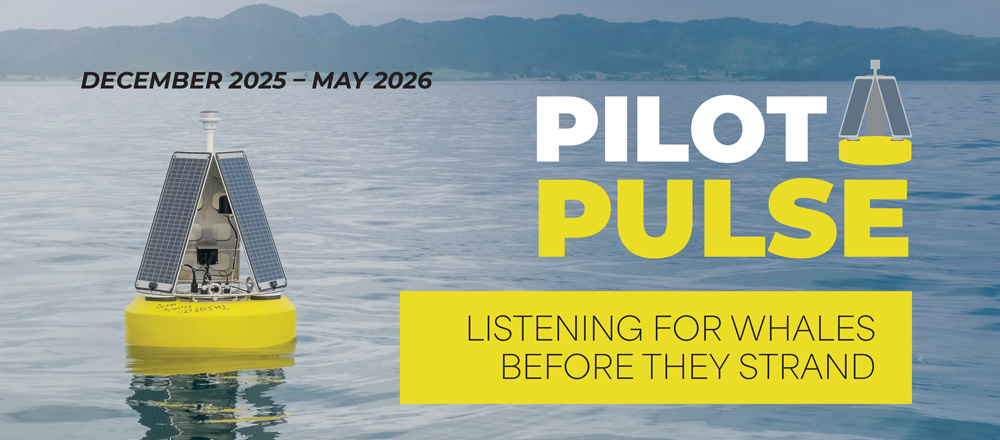
Pilot Pulse is a collaborative project between HealthPost Nature Trust, Project Jonah, Cetaware and local community and stakeholders, exploring whether artificial intelligence (AI) and underwater acoustic monitoring can help us move from a reactive response to pilot whale strandings towards an early-warning approach.
In December 2025, the first autonomous AI-powered buoy was deployed near Onetahua Farewell Spit. Over the following five months, it continuously listened to the underwater environment, detecting and recording marine mammal vocalisations while the AI adapted to changing conditions.
What the trial achieved
The buoy operated for 158 days, with 100% recording effort, providing a substantial new dataset of underwater sound from the waters around Onetahua Farewell Spit.
Following retrieval, the raw recordings were manually analysed to check for missed detections. This showed the system had a 98.7% recall rate, successfully detecting 98.7% of the actual vocalisations identified during the manual analysis. This provides strong evidence that real-time acoustic detection is feasible in this environment.

• 30 pilot whale acoustic encounters
• 38 dolphin acoustic encounters
• 20,409 raw audio files, totalling 476 GB of data
• 12 AI model updates as the system adapted to new environmental sounds
The first trial has successfully demonstrated that pilot whale vocalisations can be detected in real time using an autonomous AI-powered buoy.
A rare opportunity to listen before a stranding

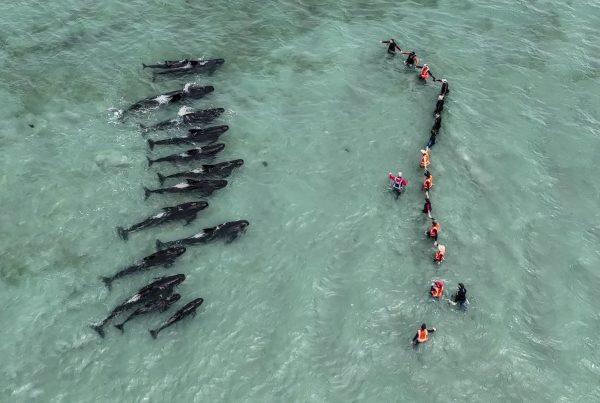
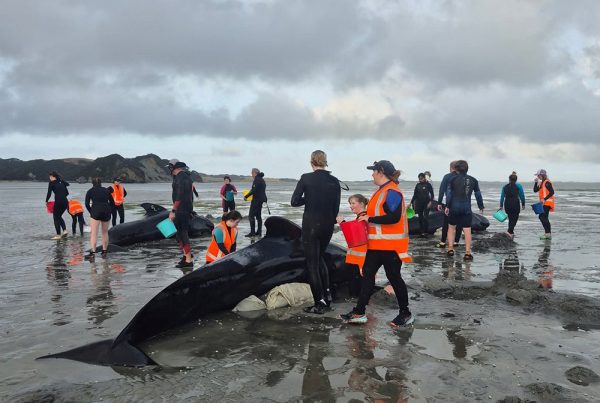
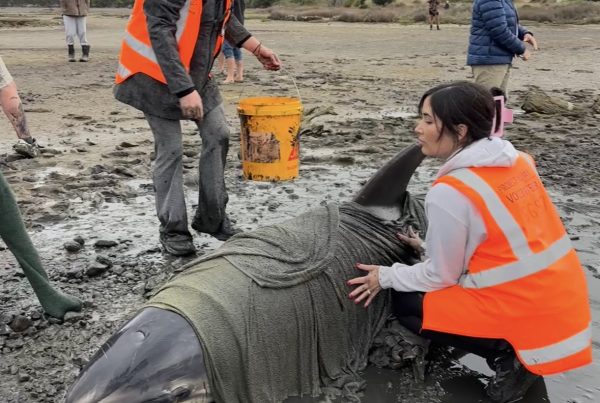
The most significant finding came on 8 January 2026, when a mass pilot whale stranding occurred in the area being monitored.
For the first time, the project had access to acoustic recordings from near the stranding site during the hours before a real mass stranding.
The recordings showed that vocalisation rates were lower than the threshold originally being used to trigger alerts. The Cetaware team confirmed this through manual analysis and changed the alert settings that same day.
This event provided an invaluable dataset for investigating pilot whale vocal behaviour before a stranding — something the project has previously had very limited opportunity to study.
The buoy detected pilot whale vocalisations at 6:05am, with further vocalisations detected from 8:45am. The whales subsequently stranded several kilometres from the buoy.

The AI is learning too
The trial also demonstrated why adaptive AI is important in a real marine environment.
As the buoy remained in the water, fish and invertebrates settled around it, creating new biological sounds. Other sources of noise, including a mooring shackle and echo sounders, also produced false detections.
The system was able to learn from these sounds and update its models. In one example, 1,405 recordings of noise from a mooring shackle were used to fine-tune the AI so it could distinguish the sound from pilot whale vocalisations.
What comes next
The first six-month trial has demonstrated the technical feasibility of real-time pilot whale detection and provided a valuable new dataset from a real stranding event.
However, Pilot Pulse cannot yet predict when a whale will strand. Further seasons of monitoring are needed to understand whether there are consistent acoustic patterns before strandings and to validate the AI.
The next phase will focus on continuing to build this dataset, refining the AI and exploring the development of a small number of buoys.
Ultimately, a network of buoys could allow the project to move beyond detection towards localising and tracking vocalising whales in real time.
Thank you
The first Pilot Pulse trial would not have been possible without the support of Cetaware, Yondi Foundation, HealthPost Nature Trust and Department of Conservation Tākaka, alongside our deployment, technology and community partners.

Deployment partners
- Manawhenua ki Mōhua
- Tuff Buoys Ltd
- TNL International
- Sanford Limited
- Sollys Freight Ltd
Technology providers
- Ocean Acoustics Limited
- Styles Group