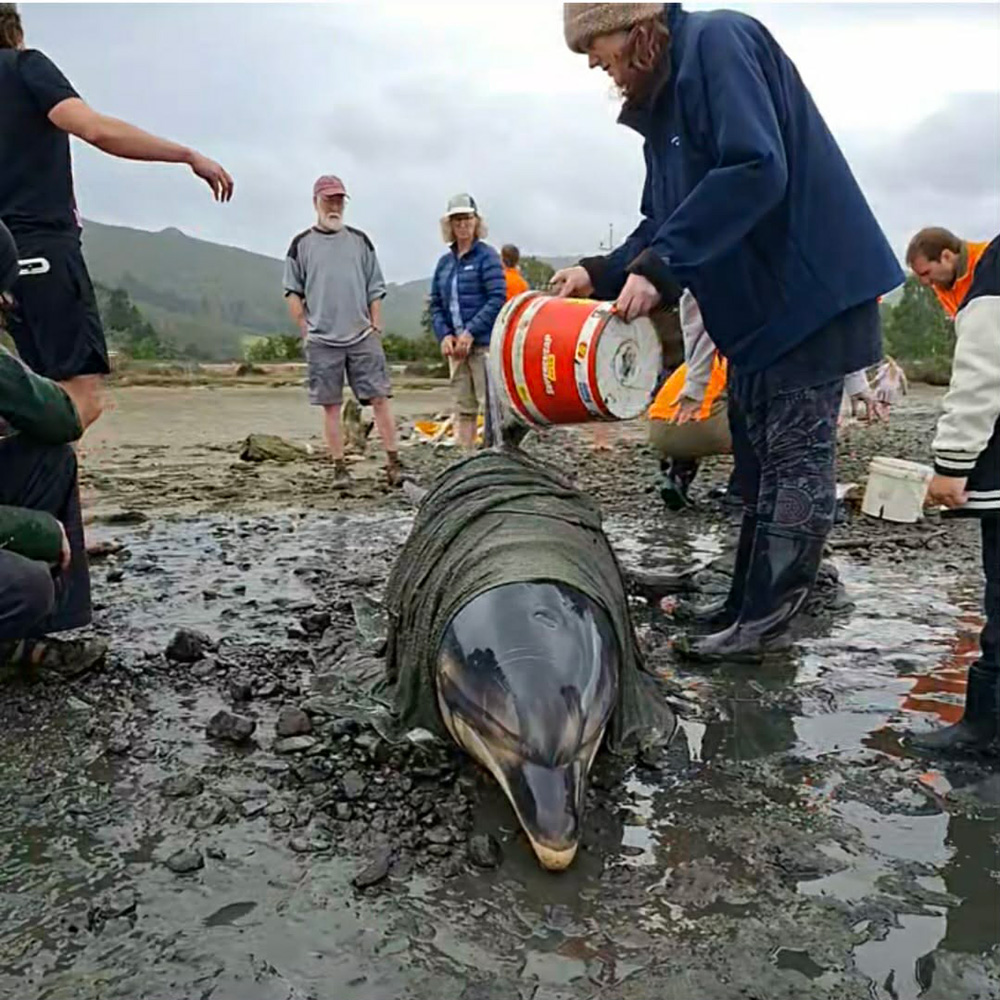
Around 3:30pm on Wednesday 10th December, I received an alert from Project Jonah advising there was a stranded dolphin in Blueskin Bay, requesting confirmation of my availability to attend.
Responding immediately, I advised I was available and before I knew it, I had received the coordinates. With my mind racing and heart pounding, I swiftly gathered everything I would need, ensured my ‘strand bag’ was ready to go, and was quickly en-route, heading out to assist.
As I arrived on-site and located the dolphin in-situ, I realised just how far from the waterline this dolphin had found herself.
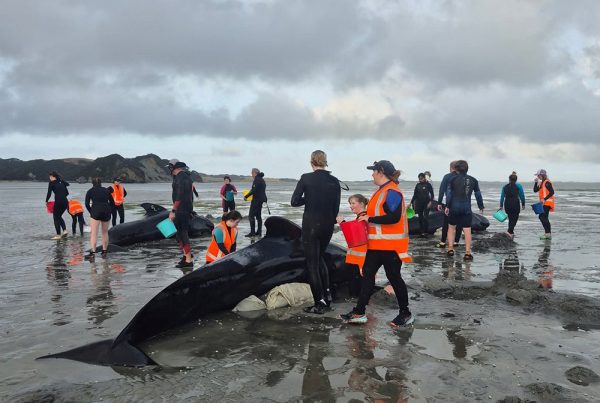
I was relieved to see a relatively good number of others present, as many hands make light work, particularly for a stranded cetacean. I immediately took my place by the dolphins side to tend to her in any way she needed during that time.
Unfortunately due to the location of her stranding, she was predominantly surrounded by rocks and stones scattered throughout sludgy sediment and silt like sand, which largely contaminated what little water was available nearby.
Thankfully a number of the community brought down buckets and soon got to work. Upon realising the state of the nearest water source, helpers took turns retrieving slightly cleaner water from a short distance further from where we were. Keeping this water in rotation allowed for the dolphin to be cared for in the best way possible, ensuring clean water was repeatedly poured over her in order to help keep her body temperature regulated and protect her skin from the exposure of being on land.
She was a beautiful bottlenose, appeared to be in good body condition, with the only visible external injury being a superficial cut to her right pectoral fin, likely from the rocks she had found herself upon. She also had a small distinctive tear along the bottom edge of the left side of her fluke, likely from an old injury.

With two Project Jonah Marine Mammal Medics present, 5 Department of Conservation staff, the incredible local iwi from Kāti Huirapa Rūnaka ki Puketeraki, some amazing crew from KiwiRail, and some very helpful members of public, the overall collective response was just incredible. The sense of community was widespread, with spirits high and hands-on support evident everywhere you turned.
After some time liaising with experts to determine her state of health, while also bearing in mind the ever-growing geographical distance from the waterline, it was clear action needed to be taken. Considering the available resources, we established the best possible next steps to help ensure this dolphin could be provided with the most positive outcome possible.
A heavy duty tarpaulin-like sling was brought in by DOC and a small group of us worked closely together to manoeuvre the dolphin ever so carefully into place. We began by gently tucking in each pectoral fin against her body to safely transfer her onto the sling. We could then commence the delicate process of slowly rolling her slightly onto her side in order to slide the rolled-up sling half way under her body. We then tucked in the other pectoral to repeat the process on the other side. This enabled us to pull the sling all the way through so that her weight was fully supported before positioning her back upright along the centre of the sling. This involves a lot of careful weight distribution all while keeping her welfare and comfort front of mind throughout.
We then determined which route would be best, resulting in the decision being made to not make a beeline for the sea, which initially felt contradictory to the purpose of our being there and our ultimate goal. However, considering the nature of the silty sludge that the current terrain consisted of and the hazard this presented, the best course of action was contrastingly to venture further inland.
As we lifted her up, I glanced down to see how she was and ensure she was still comfortably positioned. To my surprise, she had opened her eyes and was looking right back at me. A moment in time forever engrained in my mind.
And off we went.
We would carry her over towards the train tracks, leaving the beach entirely as we lifted her up and over the bank, with the idea to transfer the dolphin onto the back of a flatdeck ute and transport her to a more suitable location. This was really made possible by the assistance of the amazing KiwiRail crew who offered the service of their hiab to help us lift the dolphin up the bank and over the tracks, while also helping us to lower her gently onto the back of the ute, which was generously offered as a possible form of transport to relocate the dolphin closer to her release point.
A smaller number of us stayed with her on the back of the ute, while others provided us with enough buckets of water to help keep her comfortable, as we continued to support her and keep her upright during the relocation.
We then embarked on the next aspect of her journey, as we made our way from the back of Waitati out to Doctors Point, where we had determined the best release point to be. The very same site where just a couple months prior, we had also gathered to assist a stranded humpback whale.
The legends from Kiwirail were waiting patiently for us to arrive with the dolphin and swiftly helped us manoeuvre her safely back onto ground level, so that we could begin the walk back down to the ocean where we hoped she could be safely returned.
The incredibly committed group gathered around her once again, coming together in the most beautiful communal effort with zero hesitation. All with what felt like a silent knowing of the deeper sense of purpose that had brought us all here together at this point in time; to help return this taonga back to the ocean where she belongs.
We lifted her up, bearing the weight of her amongst us all, and carried her carefully down to the water’s edge. We repositioned ourselves ensuring she was well-balanced, before we lifted her up one last time, and made our way into the shallows, allowing the ebb and flow of the tide to wash upon her once more.
There, we stood with her still, supporting her in the sling while giving her the time and space needed to feel the rhythm of the ocean again. Taking this time helps her regain her equilibrium and orientation as she feels the rocking motion of the tide. It also provides the rescuers the opportunity to observe her more closely for any signs of her strength returning, as well as being able to make a more accurate assessment of her ability to independently swim again, so that she was able to safely make her own way back out to sea.
A few minutes had passed, a few more steps taken into slightly deeper water, and sure enough, her fluke began to gather strength, her body began to show more signs of movement, her rhythm of breathing regulated, and you could just feel, she was ready.
We dropped the sling simultaneously and waited with bated breath to see what would happen. At first, she hovered just slightly while adjusting to the sling no longer supporting her. I gently placed my arms underneath her torso, remaining aware of her fin placement and body movements, and gently helped usher her ever so slightly forward. And with this final touch of encouragement, she regained her independence and off she went, swimming delightfully back out to sea.
Blessing us all with one last show of thanks, she surfaced, showing off her perfectly proportioned dorsal fin just out from where we were standing. The air instantly filled with cheers of triumph, heart-warming waiata, excited clapping, and a collective exhale of relief.
With tears welling up in my eyes and my heart bursting with joy, I bid farewell to this beautiful animal and wished her all the best for her journey ahead.
The local surf lifesaving crew then continued to monitor her from a distance, reassuring us on the shore that she was indeed making her way further and further back out to sea. Success.